



The Milan-Cortina 2026 Winter Olympics are not just a global sporting event: they are an accelerator of urban transformation, a catalyst for investment and a once-in-a-lifetime opportunity to redefine the city’s architectural identity.
New Olympic architecture includes the Olympic Village in Porta Romana, destined to become one of the most advanced examples of sustainable urban reconversion in Europe. It is joined by the new Santa Giulia Arena, destined to become a permanent cultural landmark, and the symbolic urban bivouac project, which translates Alpine identity into a contemporary architectural gesture in the metropolitan fabric.
In this scenario, Milan does not simply build new structures: it builds legacy, value and prestige.
The Olympic Village in Porta Romana: a new idea of a neighborhood
The Milan Olympic Village, designed by the international firm Skidmore, Owings & Merrill (SOM), represents the most significant intervention in Olympic Milan. Located in the area of the former Porta Romana railway yard, the project stems from a rare opportunity: to transform an urban void into a sustainable, intergenerational neighborhood that is deeply integrated into the fabric of the city.
Six new residential buildings alternate with two restored historic structures, the Rialzo Squad Building and the Basil Building. Not a closed complex, but a permeable urban texture of courtyards, alleys and public connections.
During the Games, the village houses the athletes. Soon after, it will be converted into university residences and housing for young people and families, following a zero-waste reuse logic. This is the strength of the project: having been conceived from the beginning as a permanent part of the city.
We had talked about this and other emerging neighborhoods in Milan here.
Architecture and identity: matter, memory and contemporaneity
The new residences reinterpret tradition with a measured but sophisticated material palette: local stone, exposed concrete, and thin plaster applied over prefabricated solid wood panels.
It is an operation that speaks the language of Milanese heritage: respect for memory, technological innovation and attention to detail.
A distinctive feature of the project are the large communal terraces placed at the ends of the buildings.
Sustainability as an urban investment
The Olympic Village is designed according to smart city and environmental resilience principles, like other new Olympic architectures. Mechanical systems are integrated with district networks; photovoltaic panels on rooftops generate renewable energy; passive cooling strategies, permeable surfaces, and rainwater harvesting contribute to climate resilience.
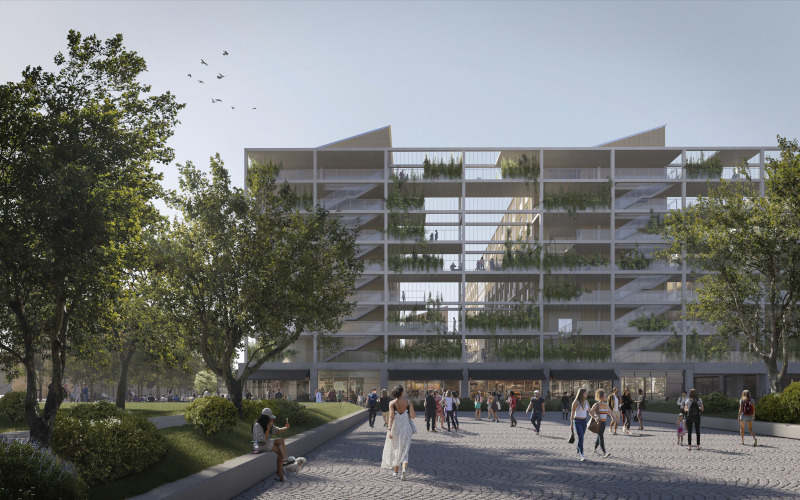
Credits: Dave Burk SOM
Santa Giulia Arena: Olympic infrastructure and permanent urban architecture
Redefining the southeastern axis of the city: theSanta Giulia Arena, designed by the firm David Chipperfield Architects in collaboration with Arup for the structural and plant engineering part. It is not simply a sports facility, conceived to combine technical performance, functional flexibility and architectural quality.
With a capacity of about 16,000, the arena hosts ice hockey competitions during the Games, and then transforms into one of Italy’s main hubs for concerts, large events, shows and indoor sports events.
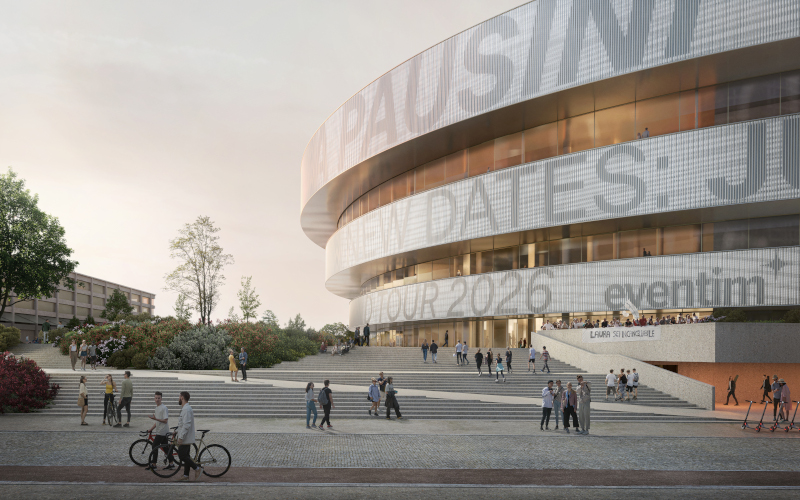
Credits: Onirism Studio
The building is developed around a compact elliptical plan, which recalls the archetypal classical amphitheater but is reinterpreted through a rigorous contemporary language. The arena is defined by a continuous façade punctuated by vertical elements and light metal surfaces; it is capable of filtering light and generating material vibrations during the day. At night, the envelope transforms into an urban lantern through the integration of dynamic LED systems.
Collaboration with Arup enabled the development of a high-performance structure: large pillarless interior lights provide maximum stage flexibility, while the acoustics are designed to accommodate both sports and musical needs.
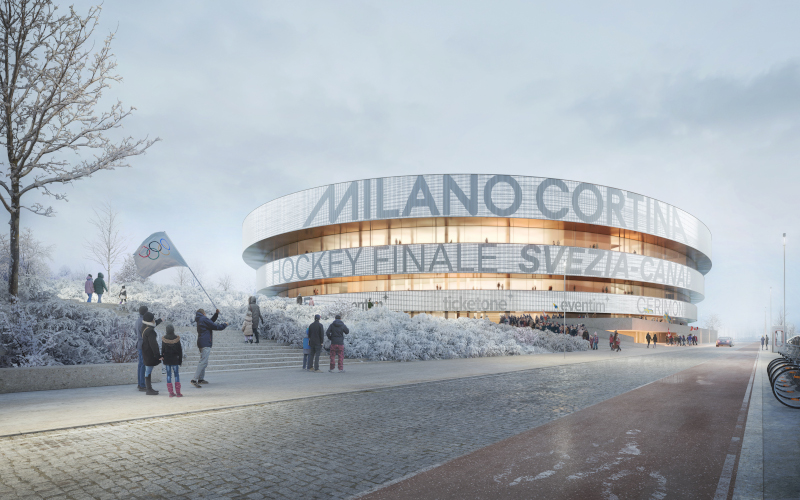
Credits: Onirism Studio
The arena is part of the broader regeneration plan for the Santa Giulia district, a strategic area already the subject of major real estate investments. Its location, close to the main transportation infrastructure and connected to the metro network, makes it a new attractive pole capable of activating collateral economies – retail, hospitality, residential – strengthening the entire urban sector.
Consistent with David Chipperfield’s design signature, the building privileges proportion, rhythm and material solidity. It is an architecture that dialogues with the city without imposing itself on it, that builds identity through measure and not through spectacle. A contemporary landmark that reflects Milanese elegance: discreet, cultured, and destined to last.
The urban bivouac: a symbol between city and mountain
Among the new Olympic architectures emerges the urban bivouac, inspired by alpine huts reinterpreted in a contemporary way. This temporary architectural device becomes a space for stopping, observing and meeting.
In the context of an Olympics uniting Milan with the Dolomites, the urban bivouac represents a symbolic bridge between the metropolis and the alpine landscape. Its presence introduces an experiential dimension to public space: not just infrastructure, but identity narrative.
The new project by CRA-Carlo Ratti Associati, realized in collaboration with Salone del Mobile.Milano: a high-altitude bivouac, designed for the Olympics, capable of disappearing among the rocks and at the same time telling a new idea of alpine architecture, sustainable and visionary.
Bivouac 2.0 is an urban pavilion during the event, it will then be installed in the mountains, available to hikers.
Milan, the capital of design, thus transforms even a temporary element into an object of architectural and cultural experimentation.
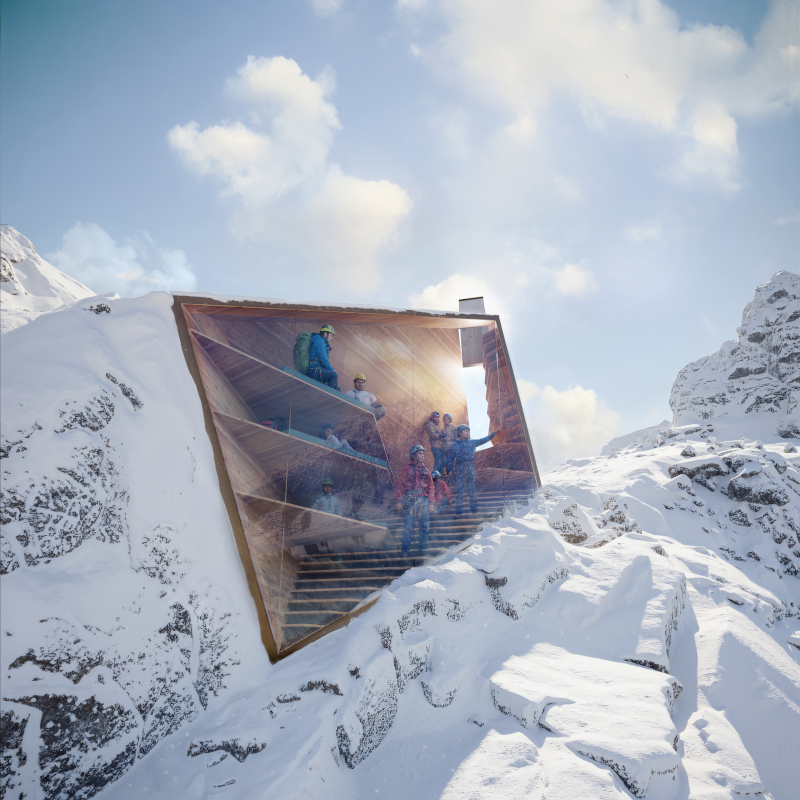
Credits: Carlo Ratti Associates
A model of regeneration beyond the event
What distinguishes the Milan approach is the desire to avoid cathedrals in the desert. New structures are not created to run out with the event, but to activate lasting economic and social cycles.
The Olympics thus become an accelerator of urban quality, capable of affecting the residential market, international attractiveness and Milan’s positioning among the great European capitals.
Milan 2026: modernization and prestigious style
Milan has over the past two decades built an identity based on regeneration, contemporary architecture and strategic investment. The works related to 2026 consolidate this path.
The city proves that prestige does not come from exceptionalism for its own sake, but from coherence between memory and innovation, between sustainability and real estate value. New Olympic architectures are not just buildings: they are tools of urban transformation, long-term assets, catalysts for new communities.
With this in mind, Milan is preparing to become, once again, a European model of elegant, sustainable and forward-looking modernization.
Find here all the prestigious residential proposals in Milan